A decade of the China Australia Free Trade Agreement: What comes next?
26
March
2026
4
min read
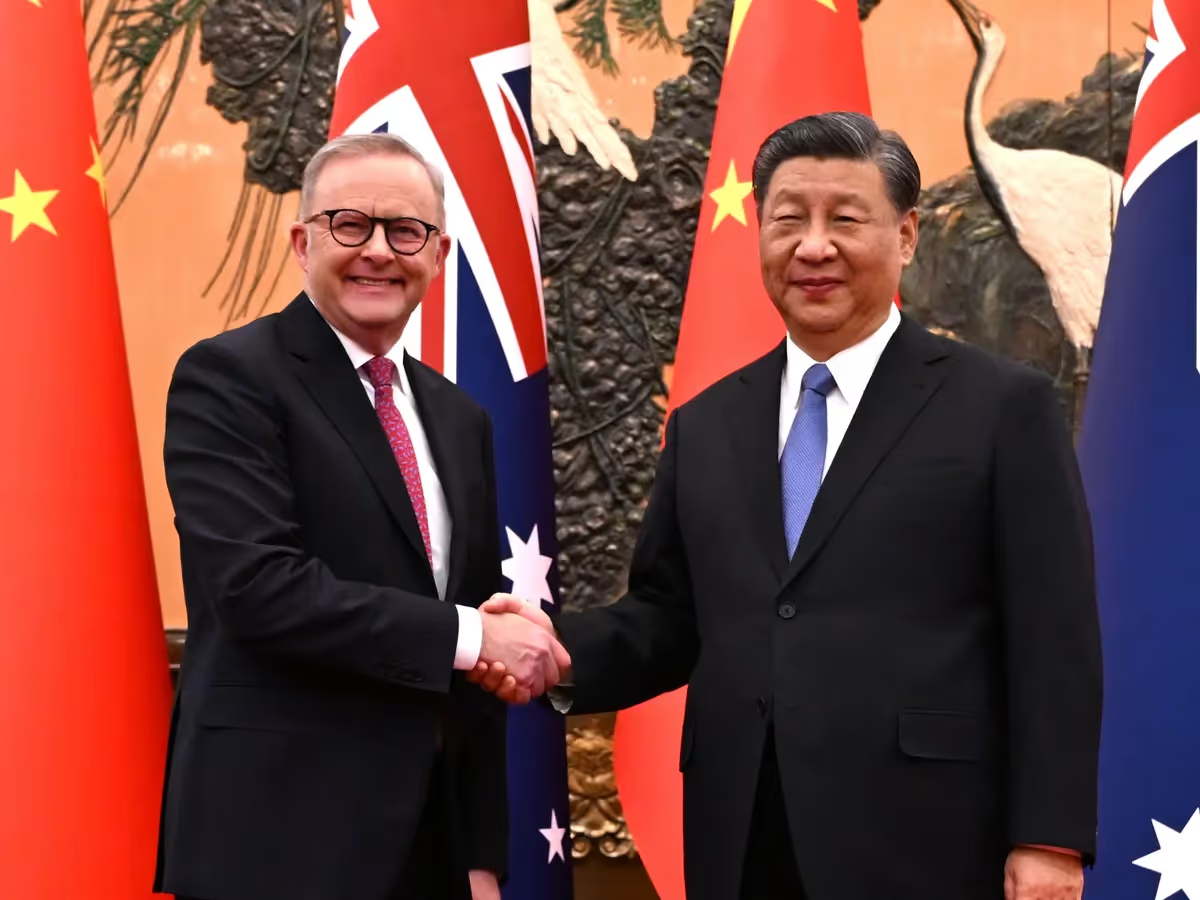
In July 2025, Australia and China formally agreed to review ChAFTA. This insight examines what the review needs to address and the considerations shaping Australia's approach.
Introduction
When the China-Australia Free Trade Agreement (ChAFTA) came into force in December 2015, its central promises were lower duties, greater market access, and mutual economic gains. A decade on, the agreement has broadly delivered on that promise. Bilateral trade has surpassed $210 billion annually and concerns raised at the time about the impact on Australian workers have not materialised.
In July 2025, during Prime Minister Albanese's visit to Beijing (the first by an Australian Prime Minister in seven years) Australia and China signed a Memorandum of Understanding (MoU) formally beginning a review of the agreement. Both governments have signalled a desire to upgrade it; consolidating gains in traditional areas like agriculture and mining, while exploring new ground in emerging sectors.
But the review is happening at an unusually complex moment. US tariffs are reshaping global trade flows, the nature of trade itself has shifted, and the new economy runs on data, artificial intelligence, and green industrial inputs that were much less contemplated when ChAFTA was first negotiated.
The easy gains have been banked and success markers will be more challenging in this iteration of the agreement.
Key Facts and Figures
- China has been Australia's largest trading partner, export destination and source of imports for 16 consecutive years.
- Total bilateral trade surpassed $210 billion in 2024.
- ChAFTA supported an estimated 595,600 Australian jobs.
- Australia's share of China's import base has grown from 4.5 to 5.7 per cent since ChAFTA was signed.
Policy Landscape
What the original ChAFTA delivered?
In the decade since ChAFTA entered into force, trade between Australia and China grew significantly, outpacing Australia's trade growth with the rest of the world. The concerns most loudly raised at the time that Australian workers would be displaced by Chinese labour, or that economic dependence would compromise Australia's foreign policy independence did not materialise in the ways critics feared.
Australian governments continued to raise points of difference with China. For instance, on Huawei, on foreign interference, on AUKUS but the economic relationship continued regardless. When China imposed trade coercive measures in 2020, Australia redirected much of the lost trade to other markets. The relationship proved more resilient than many predicted.
The diplomatic reset and the review
The 2020 restrictions marked the low point of the bilateral relationship. But by 2022, a diplomatic thaw had begun; most restrictions have since been lifted, and the relationship has entered a period of stabilisation.
The MoU signed in July 2025 formally initiated the review process. China has framed its ambitions broadly, nominating AI, green energy, healthcare and the digital economy as priority areas. The review is also being shaped by external forces: US tariffs on Australian goods have added urgency to Australia's interest in deepening other trade relationships.
During his Beijing visit, Prime Minister Albanese signalled that Australia intends to make its own independent foreign policy decisions, rather than simply following the lead of its allies as the lines between economic and security relationships become increasingly difficult to navigate.
Businesses, industry groups and other stakeholders have until 31 March 2026 to make a submission to DFAT's General Review of ChAFTA – a direct opportunity to shape the terms of the agreement for the next decade.
Challenges
Navigating the Washington-Beijing squeeze
Australia finds itself in an increasingly uncomfortable position between its most important security ally and its most important trading partner. The Trump administration's tariffs have strained the economic dimension of the US alliance. At the same time, the 2022 reset in Australia-China relations has seen reduction in tariffs which has facilitated strengthened business-to-business trading opportunities.
The ChAFTA review will be read in Washington as well as Beijing, and Australia will need to demonstrate that deeper economic engagement with China is consistent with its alliance obligations.
An agreement seen as too accommodating of Chinese strategic interests risks damaging trust with the US and AUKUS co-signatories. One too heavily shaped by US security logic risks the economic relationship with Australia's largest trading partner.
The AI and data dilemma
China's ambassador has explicitly nominated AI as a priority area. There is a genuine economic logic to this. Australia's most recently concluded free trade agreements, with the United Kingdom and the United Arab Emirates, both incorporated provisions on emerging technologies including AI — establishing frameworks for research collaboration, commercialisation, and joint governance. A ChAFTA 2.0 without any AI dimension would look conspicuously incomplete.
However, there are several risks with including AI provisions and Australia has experience with this dilemma. In 2018, the Turnbull Government excluded Huawei from the 5G network — a decision framed not as a narrow technical judgment but as a call about sovereign control over critical infrastructure. In hindsight, most analysts consider it the right call. The question now is whether Australia applies the same logic to AI before it becomes similarly entrenched.
The Australian Strategic Policy Institute has warned that deeper AI cooperation with China risks locking Australia into "technology ecosystems shaped by China's interests, not ours." The concern is not hypothetical. In solar panels and batteries, Australia's heavy reliance on Chinese supply chains has already created the kind of strategic concentration that leaves limited room to manoeuvre.
Compliance complexity as a barrier to genuine partnership
A capability gap runs in both directions. A February 2026 Report by the Australia-China Business Council found that only one third of Australian businesses are genuinely confident doing business with China with the weakest scores recorded in localisation and in-market operation. As the review progresses, that gap will matter.
For Chinese businesses operating in Australia, compliance is not a one-off legal hurdle. It is a cumulative, continuously evolving operating environment shaped by tax obligations, workplace regulation, privacy and cybersecurity expectations and ESG disclosure requirements that are hardening from soft expectations into conditions of market access.
Two features make this particularly challenging. Firstly, many Chinese firms enter Australia with a sales-first mentality, underinvesting in the governance foundations that Australian regulators expect.
The second issue is one of pace outrunning preparation. Australian regulatory obligations are tiered, and crossing certain revenue or workforce thresholds triggers new requirements. A company that grows quickly can find itself subject to rules it never anticipated, not because it was careless, but because its internal governance did not keep pace with its commercial success.
The electric vehicle sector illustrates this well. Chinese brands have discovered that the real challenge is not selling cars. It is building financing relationships with Australian banks, navigating strata regulations for apartment charger installations, maintaining local service and parts networks, and sustaining public trust on data handling. BYD's decision to store Australian customer data on Australian servers reflects an understanding that market access increasingly depends on governance credibility, not just price and performance.
21
September
2026
.jpg)
2026 Australian Political Book of the Year Shortlist announced
Read news article
21
September
2026
2026 Australian Political Book of the Year Shortlist announced
Download White Paper
20
September
2026

Victorians want conviction, not comfort
Read news article
20
September
2026
Victorians want conviction, not comfort
Download White Paper


To receive York Park Group updates via email, please subscribe
