
PulseCheck draws on data and research to determine Australia’s ‘pulse’, to help organisations understand the environment in which they seek to build trust and change minds.
The Score
Q2 2026
-14
Score between -50 to +50
Australia Absorbs the Shock
- The Pulse fell nine points to -14, its lowest reading since the pandemic.
- The national mood hit -30, the lowest reading on record, but discretionary spending rose.
- Persistent inflation and low growth indicate the worst is yet to come.
Q2-2026 Analysis
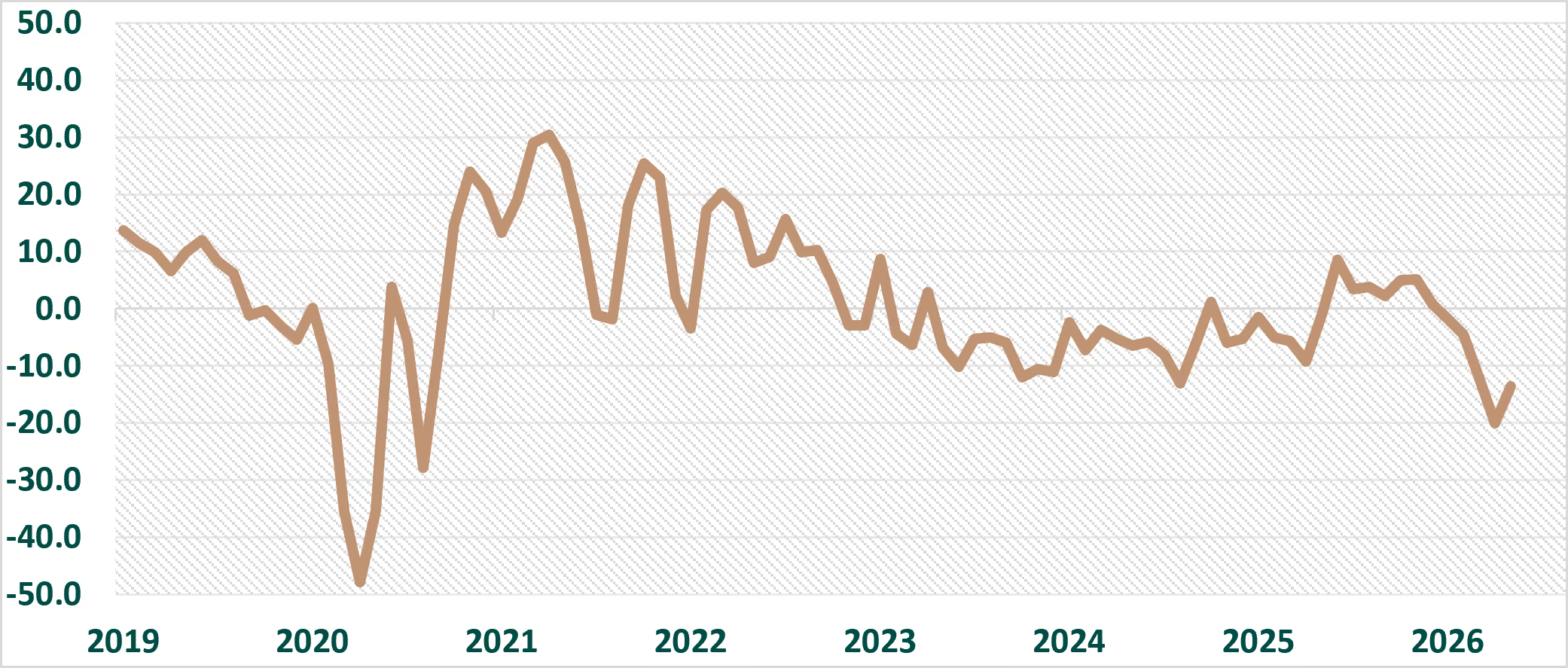
The Pulse fell nine points to -14 in Q2, its lowest reading since the depths of the pandemic in mid-2020. What Q1 signalled, Q2 has confirmed: Australia is absorbing the compounding shocks of the Middle East conflict, energy costs, rising interest rates and persistent inflation.
This coincided with unpopular measures in the Federal Budget, positioned as seeking to rebalance Australia's tax system. Despite a series of significant concessions since, it was viewed by many as a broken election promise that the Albanese Government would not to make changes to negative gearing or capital gains tax.
Business felt this directly, with NAB reporting ‘Federal Government policy’ jumped to the second most cited reason for a drag on confidence, behind only wage costs, as confidence fell to -19.
The most striking feature of the Pulse in Q2 is the gap between what Australians are saying and what they are doing. The national mood fell to -30, the lowest reading on record, yet discretionary household spending rose 2.1 per cent in May, the strongest rise since January 2024. It suggests sentiment has collapsed faster than behaviour has changed.
Outlook for Q3-2026
One Nation has surged in the polls; almost one in three voters now say they would vote for One Nation at a Federal Election, although Leader Pauline Hanson’s National Press Club speech brought scrutiny. The Victorian State Election in November 2026 will test whether the polling translates to votes.
The Pulse’s direction in Q3 will depend significantly on the decisions of the RBA. Inflation remains persistent whilst there are signs of economic slowdown. The RBA’s Chief Economist has said a period of higher unemployment may be required to reduce inflation, suggesting an economic slowdown is coming. This domestic uncertainty is further impacted by the ongoing global uncertainty.
US President Donald Trump has said an Iran War Deal is ‘close’ at least 38 times, yet uncertainty remains – and, at time of writing, there has been renewed fighting and airstrikes, which suggests the fragile deal may be unravelling. On 5 July 2026, 51 oil tankers crossed the Strait of Hormuz; so far this year, only nine have crossed. It demonstrates that, despite ongoing negotiations, the energy shock caused by the conflict will continue for some time.
Considerations
Reputation: If trust in government is falling, how does this influence our engagement with government?
Positioning: One in three voters back a party campaigning against the establishment. How do we look through that lens?
Messaging: Households and businesses are feeling the same shock differently, which audience are we communicating to?
History: 2019 to 2026
Viewing the Pulse within the context of the pandemic highlights the scale of the economic shock currently hitting Australia.
PulseCheck Methodology
York Park Group wanted PulseCheck to be an objective and subjective measurement. In developing the methodology, we considered:
- How do voters in the community feel generally against their actions?
- What are business perceptions against the decisions they make?
- How to answer these questions with data that already exists?
The Pulse is measured on a scale between -50 and +50, with 0 set as a neutral score, indicating that, socially, economically and politically, Australia is neither positive nor negative. The majority of the data sets used date back to 2019. This provides important context of where we are sitting compared to the black swan event of the pandemic.
For context, a record low -47.8 was recorded in April 2020, when business conditions and confidence were at -50 and -34 respectively as the scale of the pandemic became clear. Conversely, and coincidently exactly a year later, a record high of +30.4 is recorded, when the vaccine rollout was in full swing, with record high consumer sentiment and positive business confidence and conditions of 21 and 32 respectively.
Formula
The Pulse is formulated as a weighted sum of normalised scores assigned to each indicator. Data scientists at Klara have created linear spline functions – line segments joined at specified points – to normalise the indicators.
For each indicator, a total of 11 scores between -50 and 50 have been assigned to a representative sample of indicator’s values. The result is an adaptable but consistent and objective methodology that normalises the various indicators into a unified scale.
Once normalised, each indicator is given a weighting that determines the relative influence of the indicators on the overall Pulse score. The weightings were selected to achieve a balance between more objective measures that reflect actual spending or economic conditions (e.g. ABS data and NAB business conditions) and more subjective measures that reflect consumer sentiment, business confidence, and political satisfaction. The weightings for each source are set out below.
Indicator
Weighting
Q2 2026 Change
ABS Household Spending Indicator
20%

Westpac and Melbourne Institute Consumer Sentiment Index
20%

NAB Business Survey – Confidence
20%
NAB Business Survey – Conditions
20%
Essential Media – National Mood
10%

Resolve Country Outlook Index
10%
Consistent Updates
Together, York Park Group and Klara have built PulseCheck to capture changes in Australia’s economic, social and political climate.
PulseCheck offers a data-driven lens through which organisations can proactively manage their reputation in a dynamic and often unpredictable environment. As new sources emerge, PulseCheck will continue to refine its approach – remaining a reliable, transparent, and relevant guide for decision-making in an increasingly complex world.
Download
Click below to download the two-page report.
To receive York Park Group updates via email, please subscribe
